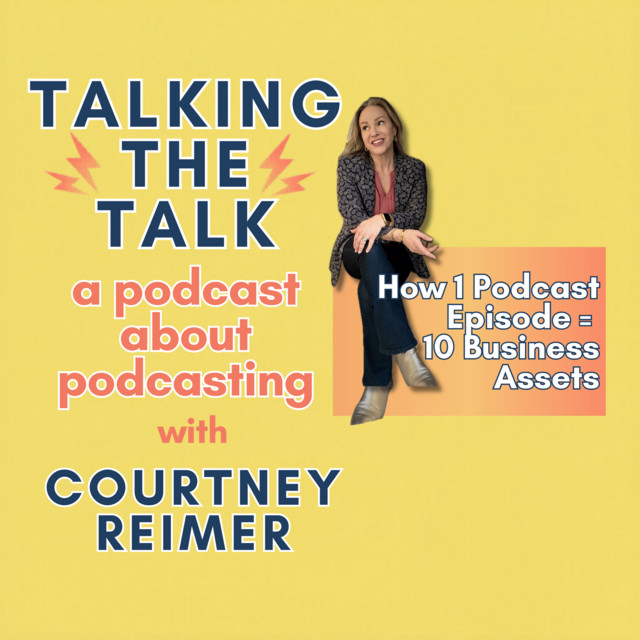
I’d plead for forgiveness for committing self-plagiarism, but that would undermine my entire point.
One of the questions I get most often from entrepreneurs is some version of:
“Where do you find the time to create all this content, Courtney?”
Adding: “I’d really love to have a podcast, but I also have to [INSERT ONE OF THE FOLLOWING]...
- Write my book
- Focus on this month’s Instagram challenge
- Build up my YouTube channel
- Do more newslettering
So while I absolutely eschew the false narrative that we can have or do it all, some weeks I actually do manage a podcast, a newsletter, a LinkedIn post or two, a YouTube Short, an Instagram Reel, a carousel, and maybe a workshop.
(Writing a book is one thing I've managed to keep out of my shiny object collection...for now.)
And the deeply unsatisfying answer to the “where do you find the time?” question is:
I don’t find the time.
Until they invent a time-generating machine (how is it that Waymos exist, but we’re still stuck with the same 24 hours each day??), I rely on my own time-wrangling invention:
Return on Thinking analysis. (Unfortunate acronym; highly fortunate litmus test.)
Being an entrepreneur requires exponential obligation to show up in more places than “quietly” does in copy generated by Claude & co.
Before I commit my brain to an hour bringing an idea into coherent existence, I need to know my mental effort will earn its keep–I want to know it’s going to lighten the cognitive load for Future Courtney.
So, when a flash of supposed brilliance strikes me while I’m walking my dog, or an idea for a podcast guest comes to me while I’m taking out the recycling, I run it through my Return on Thinking rubric:
- Will this just be another piece of content with a best-by date of tomorrow
- How many decisions will this eliminate for future me?
- Could this become rich source material, or is it just one cool idea?
- How many assets could this one thinking session return for me?
The answers to those questions result in a → Flywheel inventory → that looks like this:
→ One return-on-thinking asset: (i.e., a single, standalone LinkedIn post)
= toss it in the “return to later…or more likely never” file
→ Three to four assets: (i.e. the central topic of a podcast episode that spins off a pithy IG Reel that becomes the basis of a LinkedIn post that I can tag a colleague to start a conversation about a potential speaking gig)
= toss that gem into the content-creation oven.
To be clear: I didn’t wake up like this. I codified this “return on thinking” litmus test after I noticed a pattern:
When my podcast episode contains an especially meaty idea, the rest of my week gets easier.
✔️The newsletter practically writes itself.
✔️LinkedIn isn’t rudely staring back at me like, “Well? You gonna say something?”
✔️Client conversations get livelier because I have a fresh story to tell.
✔️Lessons for my cohorts seem to appear out of nowhere. (Only they're not coming out of nowhere. They’re coming out of something I learned in the episode I just recorded.)
High “return on thinking” content is like a gloriously flourishing tree whose many branches provide nice, temperature-regulated places for your ideas to hang out for a while.
I confess I do sometimes need reminding that every blank page is expensive, and every empty Google Doc is like an invitation to go down another Reddit rabbit hole.
It helps to remember that these rubrics and flywheels are meant to support and amplify our most valuable outputs:
- The weird connections your brain alone can make.
- The perspective & expertise you’ve spent years accumulating.
- The ideas that wouldn’t exist if you’d spent that hour answering email instead of taking a break under a nice, big shady tree.
Those are finite commodities.
I’d rather cultivate them once, propagate 4x, then go outside for a stroll so I can come up with my next big Return on Thinking idea.