Hot takes & hot tips on how to build, sustain, and maximize the ROI of podcasts that earn their keep.
Subscribe below to join the weekly-ish fun...
SHARE
Me being human
Podcasting is head and shoulders (no pun intended) above all other forms of content marketing because it’s nearly impossible to sand off all of the humanity in it.
For years we (ok, *I*) have treated the following as podcast blemishes to cover up, apologize for, or wish away.
✔️The host (🙋♀️) that can’t find her go-to-list of rapid-fire questions so has to wing it live
✔️The guest whose dog finds the least opportune times to make its voice heard
✔️The sound quality that makes very clear that a fallible human was involved in the making of this recording
Now, when I find myself swimming in the sea of AI-slop and Claude-conceived sameness permeating LinkedIn and other written-word media, I come back to podcasts. And I feel truly enriched and heartened.
Particularly when I hear a “mistake” in a podcast that I admire. It’s how I know that the creator of that podcast is for certain a human–and therefore someone I feel I can trust.
Alas, we humans are limited by the laws of time in ways that our robot overlords are not. And as readers of this newsletter well know, I’m acutely aware that time is our most valuable asset.
Time is valuable, but some parts of time--and how we spend them--are more valuable than others.
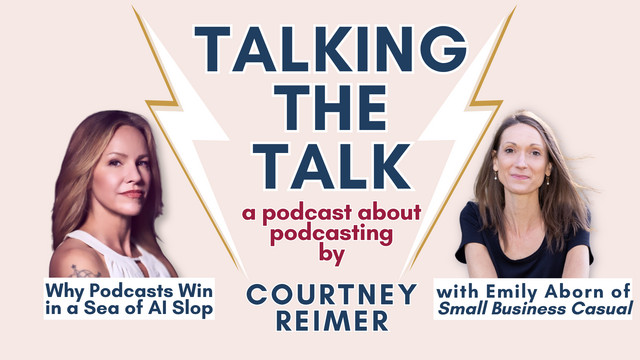
As Emily articulated so well (both on my show and her own) if we lean on AI too hard by asking it to save us time we’d have otherwise spent doing the very thing people hire us for, we run the risk of devaluing our work. And maybe even ourselves.
When you’re in the business of selling your expertise, YOU (aka your brain, your singular ideas, your years spent racking up hard-won wisdom) are the most valuable part of your business.
To put it more bluntly: you are the product (not Chat, not Claude).
So, it is in your best interest to build a moat around your kingdom of POV to protect it from the AI invaders.
If you’re saying to yourself, "Surely Courtney is not suggesting to go back to the dark ages and type out our work on a Corona No. 3 folding typewriter."
No, my friend. I’m suggesting you ask yourself this question:
What can I afford to farm out to AI?
Leaving aside the fallacy of agency when it comes to opting into AI here in the year twenty twenty six (see: Google AI-summarized search results, Shazam, Siri, Alexa), consider my...
Go/No Go mental flowchart on whether or not to use AI in my work:
❓Is this output a direct reflection of what people pay me for?
YES → My brain. My hands. My voice.
NO → Ask one more question.
⬇️
❓Could another person (or bot) produce an equally good—or better—result?
YES → Happily hand it over to the machines.
NO → That’s probably where my best minutes belong.
Incidentally, AI made this flowchart.
Let AI transcribe the interview. Let do a logic problem that is beyond the ken of your beleaguered brain. Let it organize a year’s worth of newsletters into recurring themes.
In fact, that’s exactly what I’ve encouraged members of my podcast-development cohorts to do.
When someone is struggling to find a unifying theme for their show, I instruct them to gather as much of their body of work as possible–LinkedIn posts, newsletters, blog posts, podcast appearances, instagram captions, etc–and feed it into the LLM of their choosing.
What emerges is a throughline of their thought leadership that AI is often more effective at unearthing because:
We are too close to our material to be able to see the thematic forest for the trees
Depending on the size of your body of work, we would need a full extra day to sift through it all. (Or in my case: approximately three Saturdays and several unnecessary office-reorganizing sidequests.)
Again, not all minutes are created equal.
An hourlong recording session–even one riddled with oddities and errors (maybe especially one with those?)--is infinitely more valuable than the 2-3 hours I might spend futzing with EQ settings trying to make an episode sound three percent clearer.
One of those things creates trust, connection, and content that screams "I'm a human like you!"
The other just creates…slightly better sound quality?
Trust is why people work with us, follow us, hire us. Perfect content is almost suspect in the age of AI.
Ahoy, my typo-prone, stuttering brethren.
Our time has come, and the podcast world is our oyster.
Lately I’ve been hearing less “how do I make a podcast?” and more “how do I make a podcast that’s really representative of ME?”
Good news: if you’ve been creating any content of any kind at all, you have great source material to work with.
Gather up your past newsletters, blog posts, LinkedIn articles, or even speaking engagement transcripts and ask questions like:
What themes keep showing up?
What ideas do I keep returning to?
What do I seem to believe that I didn’t even realize I believe?
What tensions or frustrations do I repeatedly write or speak about?
If someone binge-consumed all of this, what would they say I stand for?
The answers may (and probably delightfully will) surprise you!
We’re usually too close to our expertise to recognize our own patterns.
Don't get it twisted: this is not us asking AI to invent a whole new persona that’s meant to masquerade as you. This is us asking it to help you see the one you’ve had all along.
Hey, QQ for you...
If you have a podcast or want to start a podcast, what is challenging you most right now?
And may your best ideas flow from your very human hands (and brain, and vocal cords).
Looking forward,
Courtney
Was this compendium of podcasting hot takes + hot tips forwarded to you by a beneficent fairy godmother of some kind? Good news: you don’t have to rely on magic...